
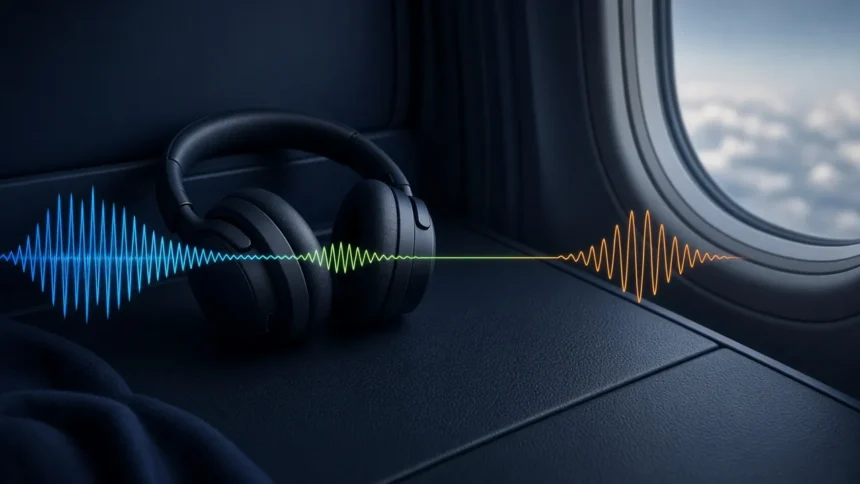
How does noise cancelling work? Microphones on your headphones listen to the noise around you, a chip creates a mirror-image sound wave called anti-noise, and the speaker plays it so the two cancel out before they reach your eardrum. It works best on steady, low sounds like engine hum and AC drone. Voices, baby cries and sudden clatter get through far more, which is why a good seal matters as much as the ANC chip.
Key takeaway
- Great at: aircraft and bus engines, train rumble, AC and fan drone, office hum.
- Weak at: nearby voices, keyboard clicks, horns, barking dogs and other sudden or high-pitched sounds.
- Fit decides a lot: the right ear tip or a snug ear cup blocks the high sounds ANC can’t touch.
- Buy for your noise: commuters and flyers gain the most; people in a quiet room with chatty colleagues gain less.
How does noise cancelling work, step by step
Sound is a pressure wave. If you add a second wave with the same shape but flipped upside down (opposite phase), the peaks of one fill the dips of the other and the result is close to silence. Active noise cancellation (ANC) does this continuously, in real time, right at your ear.
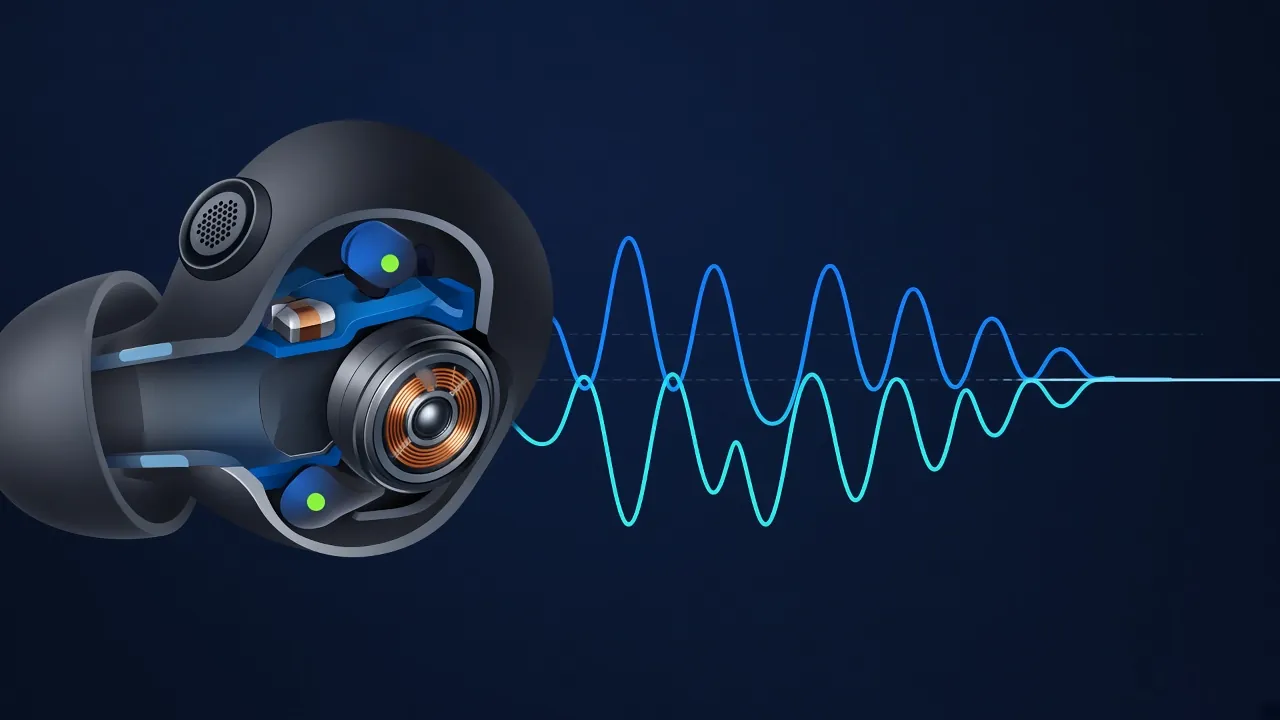
- Listen: an outward-facing microphone picks up the noise around you.
- Calculate: a processor builds the anti-noise signal, opposite in phase to the noise.
- Play: the same speaker that plays your music also plays the anti-noise.
- Check and correct: on most good headphones, an inward-facing microphone hears what is left inside your ear and the chip adjusts.
Apple describes the same loop for AirPods: outward-facing microphones detect outside sound to counter with anti-noise, and an inward-facing microphone listens inside your ear for what’s left. Its AirPods noise control support page also says ANC works best when the AirPods fit well, which is the part most buyers ignore.
Feedforward, feedback and hybrid ANC
| Type | Where the mic sits | Strength | Weakness |
|---|---|---|---|
| Feedforward | Outside the ear cup or earbud | Hears noise early, so it has time to react | Sensitive to fit and wind noise |
| Feedback | Inside, between the speaker and your ear | Corrects for what reaches your ear | Less effective on higher frequencies |
| Hybrid | Both inside and outside | Combines the two for wider coverage | Costs more; still limited on voices |
If a spec sheet says “hybrid ANC” or lists six or more microphones, that usually means both inside and outside mics. More mics don’t guarantee better cancellation; many of them are there for call quality.
What ANC blocks well, and what it can’t block
Steady, low-pitched noise is easy to predict, so the chip can match it closely. Speech and sudden sounds change pitch and volume every few milliseconds, so the anti-noise is always a little behind. Sony’s support team says it directly: the Sony noise-cancellation explainer notes that an airplane engine gets cut sharply while the person next to you still sounds clear.
| Noise | How well ANC handles it | What helps more |
|---|---|---|
| Aircraft cabin and engine hum | Very well | ANC plus a good seal |
| Bus, metro and train rumble | Very well | ANC |
| AC, fan and fridge drone | Well | ANC |
| Traffic on a busy road | Partly: the rumble fades, horns cut through | Passive seal; keep awareness for safety |
| Colleagues talking nearby | Partly | A tight seal plus music at a modest volume |
| Keyboard clicks, dogs, pressure cookers | Poorly | Passive isolation and fit |
| Wind | Can make it worse | A wind-reduction mode, or ANC off |
💡 Expert tip: in an office full of voices, play low-volume music or brown noise with ANC on. ANC removes the hum underneath, and the music covers the speech it can’t cancel.
Why fit and passive seal matter as much as the ANC chip
Every pair of headphones blocks some sound just by covering your ear. That passive isolation is strongest on the higher sounds that ANC handles worst, so the two cover each other’s gaps. Bose’s guide to what active noise cancellation is makes the same point: ANC needs passive isolation alongside it to reduce noise across all frequencies.
- Earbuds: try every ear tip size in the box. A tip that is one size too small can leak more noise than the ANC removes. AirPods Pro and several Android earbuds have an ear tip fit test in their app.
- Over-ear headphones: thick glasses frames break the cushion seal; thin metal frames hurt it less.
- Worn-out pads: flattened ear cushions leak. Replacement pads cost far less than new headphones.
- Open earbuds: designs that sit loosely in the ear (like basic AirPods 4 with ANC) can’t seal, so their noise cancelling is milder.
Who gets the most from noise cancelling
| Who | Why | |
|---|---|---|
| Best for | Frequent flyers, daily bus and metro commuters, people working near AC units or generators | Their noise is mostly steady and low, exactly what ANC removes |
| Not ideal for | Anyone who needs to hear traffic, such as cyclists and runners on roads | Reduced awareness is a safety risk |
| Not ideal for | People who mainly want to block voices in a quiet home | Fit and passive isolation matter more than ANC strength here |
| Watch out for | People sensitive to ear pressure | Some users report a stuffy, in-a-plane feeling with strong ANC; lower ANC levels or adaptive modes ease it |
A few modes are worth knowing. Transparency (or ambient) mode uses the outside mics to pipe sound in, so you can hear an announcement without removing your earbuds. Adaptive modes, like Apple’s Adaptive Audio or Sony’s Adaptive Sound Control, change the ANC level as your surroundings change, which can also make cancellation weaker than expected when you want full quiet.
Common mistakes with noise-cancelling headphones
- Expecting ANC to silence a chatty office or a noisy family home. It lowers the hum; voices still come through.
- Using the default ear tips without checking the fit.
- Leaving an adaptive or ambient mode on and blaming the ANC for being weak.
- Covering the outer microphones with a hand, cap or hoodie, which can cause whistling or howling.
- Wearing ANC while driving or cycling in traffic. Sony itself advises against using it while driving.
- Buying the strongest ANC for gaming at home, where a stable, comfortable headset matters more.
What to buy
For long days at a desk, our guide to noise-cancelling headphones for work compares the Sony WH-1000XM6, Bose QuietComfort Ultra and cheaper picks like the Soundcore Space Q45. Over-ear models seal better and usually cancel more.
For travel, earbuds are lighter and fit under a neck pillow. Our list of noise-cancelling earbuds for flights covers AirPods Pro 3, Bose QuietComfort Ultra Earbuds and budget options. On long trips, pack a universal travel adapter with USB-C so the case never dies before landing.
Gamers rarely need strong ANC, but a few headsets offer it. Our roundup of wireless gaming headsets with surround flags the Razer BlackShark V3 Pro as the pick if you game in a noisy room.
⚠️ Before you spend money: check the return window and try the fit within it. ANC strength varies with your ear shape, so a pair that impresses a reviewer may feel average on you.
How we researched this
This explainer is research-based, not hands-on. We read the noise-cancelling support material from Sony, Bose and Apple, and engineering interviews with headphone makers, then compared how each describes the limits of ANC. We haven’t measured noise reduction ourselves for this article. Last checked: November 2026.
Frequently asked questions
How does noise cancelling work in earbuds compared with headphones?
It works the same way: microphones hear outside noise and the speaker plays an opposite anti-noise wave. Over-ear headphones usually cancel more because their cushions seal better and their larger drivers produce low-frequency anti-noise more easily. Earbuds depend heavily on choosing the right ear tip size.
Can noise-cancelling headphones block voices?
Only partly. ANC cuts steady low sounds well, but voices change pitch constantly, so the anti-noise can’t keep up. A tight seal blocks more speech than the ANC chip does. Playing quiet music or brown noise on top usually covers the voices that remain.
Is ANC safe for my ears?
Yes, ANC doesn’t harm hearing; it reduces noise rather than adding volume. It can help, because you won’t need to turn music up to drown out a bus or plane. Some people feel mild pressure with strong ANC, which usually eases with lower ANC levels or breaks.
Does noise cancelling work without music playing?
Yes. ANC runs independently of your audio, so you can switch it on with nothing playing to quieten a flight, a commute or a noisy AC. Many people wear ANC headphones this way to sleep on planes or to focus in a busy room.
Why do my noise-cancelling headphones make a hissing or whistling sound?
A faint hiss is normal on some models and comes from the ANC circuit itself. Whistling or howling usually means a microphone is covered or the fit has shifted. Take the headphones off, put them back on, and keep hands, caps and hoodies away from the outer mics.
Is passive noise isolation enough without ANC?
For high-pitched sounds like voices and clicks, good passive isolation does most of the work. For low engine and AC hum, it isn’t enough; that’s where ANC earns its price. If your noise is mostly chatter in a quiet room, well-sealing earbuds without ANC can be a decent budget choice.
Is ANC worth paying extra for in budget earbuds?
Yes, if you commute or fly regularly. Even basic ANC removes a fair amount of engine and traffic rumble. Don’t expect budget models to match flagship cancellation on voices, and check reviews for wind noise, since cheaper feedforward systems often handle wind poorly.
Should I use noise cancelling while walking or driving?
Not while driving or cycling in traffic, where you need to hear horns and sirens; Sony advises against ANC while driving. For walking in busy streets, switch to transparency or ambient mode so you hear what’s around you while keeping music on.
Our verdict
Now that you know how noise cancelling works, buy it for the noise you face. If your days include flights, buses, trains or a droning AC, ANC is worth paying for, and over-ear models give the most quiet. If your problem is voices, focus on fit and passive seal first, then add music on top. Whatever you pick, test the fit inside the return window: a poor seal wastes even the best ANC chip. Once the seal is right, codec support still shapes how the audio sounds; our guide to Bluetooth codecs explained covers SBC, AAC, aptX and LDAC.