

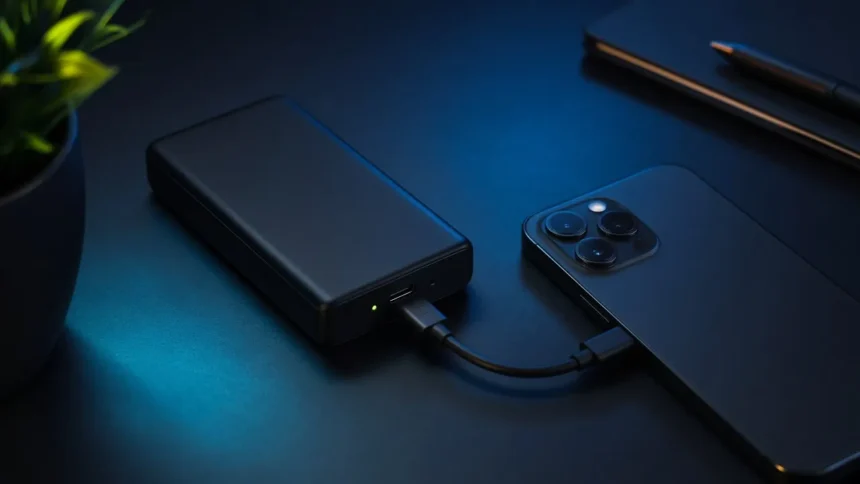
A 20000mAh power bank gives you roughly 12,000 to 13,000mAh at your phone’s 5V USB port, about 60 to 65% of the number on the box. The 20000mAh figure describes the battery cells inside at 3.7V, before voltage conversion and heat losses.
That gap is normal for every power bank. In practice a 20000mAh bank charges a 5,000mAh phone about two and a half times, not four.
Key takeaway
- mAh on the box: measured at the cells’ 3.7V, not the 5V or higher your phone charges at.
- Compare in Wh: watt-hours = mAh × 3.7 ÷ 1000. A 20000mAh bank holds about 74Wh.
- Expect 60 to 70%: conversion and heat losses mean you get roughly two-thirds of the rated energy.
- Flights: 100Wh is the limit without airline approval, which is why 27,000mAh is a common maximum.
Why mAh is the wrong way to compare power banks
Milliamp-hours (mAh) measure charge, not energy. Energy depends on voltage too: watt-hours (Wh) = amp-hours × volts. A power bank’s lithium cells sit at about 3.7V, while USB charging starts at 5V and fast charging runs at 9V or higher.
So the same 20000mAh means different amounts of current at different voltages. Watt-hours stay the same whatever the voltage, which is why airlines and serious spec sheets use Wh. Many power banks print it on the label next to the mAh figure.
The maths: where your 20000mAh goes
Two things shrink the number. Anker’s support guide on rated capacity splits them into conversion loss and circuit loss.
- Voltage conversion: 20,000mAh × 3.7V = 74Wh. At 5V, 74Wh ÷ 5V = 14,800mAh. Nothing is lost yet; it’s the same energy at a higher voltage.
- Circuit loss: the boost circuit that raises 3.7V to 5V wastes some energy as heat. At about 85% efficiency, 14,800mAh becomes about 12,600mAh at 5V.
- Your phone’s own loss: the phone converts 5V back down to charge its battery, and loses a little more as heat.
- Fast charging: higher-voltage modes such as USB Power Delivery at 9V or 20V can lose a bit more to heat than slow 5V charging.
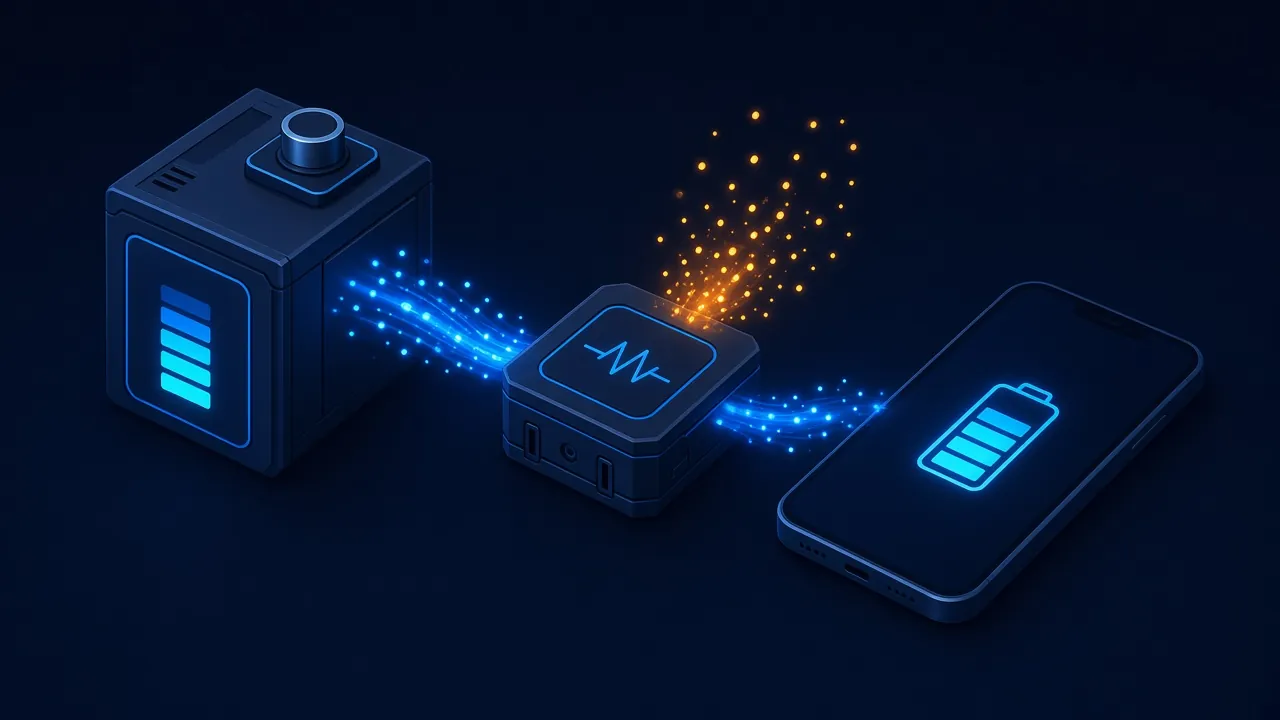
That’s why many labels show a second figure called rated capacity, quoted at 5V. It’s a more useful number than the headline mAh, though each brand measures it its own way.
How many phone charges you really get
Use this rough rule: a power bank delivers 60 to 70% of its Wh rating to your phone’s battery. A typical 5,000mAh Android phone battery at 3.85V holds about 19Wh.
| Power bank | Energy (Wh at 3.7V) | Usable at about 65% | Full charges of a 5,000mAh phone |
|---|---|---|---|
| 10,000mAh | 37Wh | About 24Wh | About 1.2 |
| 20,000mAh | 74Wh | About 48Wh | About 2.5 |
| 27,000mAh | 99.9Wh | About 65Wh | About 3.4 |
| 30,000mAh | 111Wh | About 72Wh | About 3.7 (over the 100Wh flight limit) |
For phones with smaller batteries, such as many iPhones, divide by your phone’s Wh instead. You’ll find the battery capacity in mAh on the brand’s spec page; multiply by 3.85 and divide by 1000.
Other things that cut real capacity
- Heat: charging in a hot car or a bag in summer raises losses and ages the cells faster.
- Using the phone while charging: gaming or navigation drains the battery while the bank tops it up, so fewer full charges.
- Age: lithium cells lose capacity over hundreds of charge cycles. A two-year-old bank holds less than it did new.
- Inflated claims: cheap unbranded banks sometimes print a capacity the cells can’t hold. Buy from known brands and check the BIS registration number on the label.
⚠️ Watch out for: listings that give a big mAh figure with no Wh rating, no rated capacity and no BIS R-number. Those three missing details are a good reason to skip the product.
The 100Wh airline limit and India’s DGCA rules
Airline battery rules use watt-hours. Under the FAA’s passenger battery guidance (the same IATA-based limits Indian airlines apply), spare lithium batteries up to 100Wh are allowed in cabin baggage, 101 to 160Wh need airline approval, and anything above 160Wh is forbidden. Power banks can never go in checked baggage.
A 27,000mAh bank works out to 99.9Wh at 3.7V, just under the limit. That’s why it’s the largest size most travel banks come in. In India, the DGCA advisory circular of 11 November 2025 adds that power banks must not go in overhead bins, and airlines must announce that using or charging a power bank during the flight isn’t allowed. Check your airline’s page before you fly, since some set lower quantity limits.
How to check what your power bank really holds
- Read the label: look for Wh, rated capacity (at 5V) and the cell voltage. A label with all three is a good sign.
- Use a USB-C power meter: a cheap inline meter shows the Wh delivered. Charge your phone from 20% to 100% and note the reading.
- Count charges over a week: start each charge at the same battery percentage and compare with the table above.
- Check BIS: look up the R-number on the label in the BIS registration portal to confirm the brand and model are registered.
Which capacity fits you?
10,000mAh
- Best for: daily carry and one full phone charge, with low weight in a pocket.
- Not ideal for: long trips, laptops or charging two devices.
- Watch out for: slim models whose rated capacity is well under 6,000mAh.
20,000mAh
- Best for: travel days, two or three phone charges, or topping up a tablet.
- Not ideal for: pockets. Expect a noticeably heavier bank.
- Watch out for: low output wattage if you want to charge a laptop too.
25,000 to 27,000mAh
- Best for: laptop users and long trips, staying under the 100Wh flight limit.
- Not ideal for: everyday carry.
- Watch out for: anything over 27,000mAh at 3.7V, which crosses 100Wh and needs airline approval.
Common mistakes
- Expecting the box mAh divided by your phone’s mAh to equal your number of charges.
- Comparing power banks by mAh when their cell voltages or output ratings differ. Compare Wh and rated capacity.
- Packing a power bank in checked luggage, which isn’t allowed on any flight.
- Leaving a power bank in a hot car, which speeds up cell wear.
- Buying the cheapest high-mAh listing with no Wh or BIS details on the label.
What to buy
For a pocket bank that covers one full charge, see our picks of the best 10000mAh power banks. Frequent travellers should start with our 20000mAh power banks with fast charging, and pair one with a universal travel adapter with USB-C for trips abroad.
iPhone users who prefer cable-free charging can look at our wireless power banks for iPhone, though wireless charging loses more energy than a cable. For camping and treks, our solar power banks for outdoor use explains what solar panels on a bank can and can’t recharge.
How we researched this
This explainer is research-based. We used Anker’s published explanation of rated capacity, the FAA’s passenger battery rules and DGCA’s November 2025 advisory circular. The charge counts are our own estimates from the watt-hour formula, not measured tests. Last checked: November 2026.
Frequently asked questions
Why does my 20000mAh power bank not charge my phone four times?
The 20000mAh figure is measured at the cells’ 3.7V. After converting to 5V and losing energy as heat in the power bank and the phone, you get roughly 60 to 70% of the rated energy. That works out to about two and a half charges of a 5,000mAh phone.
What is rated capacity on a power bank?
Rated capacity is the output a power bank can deliver at its USB voltage, usually 5V, after conversion losses. It’s printed on many labels next to the headline mAh. For a 20000mAh bank it’s often around 12,000mAh, which is closer to what your phone will receive.
How do I convert mAh to Wh?
Multiply mAh by the cell voltage and divide by 1000. For most power banks the cell voltage is 3.7V, so 20,000mAh × 3.7 ÷ 1000 = 74Wh. Watt-hours let you compare banks fairly and check airline limits, because they measure energy rather than charge.
How many times can a 10000mAh power bank charge a phone?
About once for a 5,000mAh phone, and a little more for phones with smaller batteries. A 10000mAh bank holds 37Wh, and around 24Wh of that reaches the phone after losses. Using the phone while it charges reduces the number further.
Is a 20000mAh power bank allowed on flights in India?
Yes, in cabin baggage only. A 20000mAh bank at 3.7V is about 74Wh, under the 100Wh limit that needs no approval. DGCA’s November 2025 circular says you can’t use or charge it during the flight or keep it in the overhead bin. Check your airline’s own limits too.
Why is a 27000mAh power bank the biggest you can fly with?
At 3.7V, 27,000mAh equals 99.9Wh, just under the 100Wh limit for cabin batteries without airline approval. Larger banks between 101 and 160Wh need the airline’s permission, and anything above 160Wh isn’t allowed on passenger flights.
Does fast charging waste power bank capacity?
Slightly. Fast charging raises the output voltage to 9V or more, and the extra conversion and heat can cost some energy compared with slow 5V charging. The difference is usually small next to the convenience, but slow charging overnight squeezes out a little more.
Do power banks lose capacity over time?
Yes. Lithium cells wear with each charge cycle and with heat, so a power bank holds less after a year or two of regular use. Store it partly charged in a cool place, and avoid leaving it in hot cars or direct sun to slow the wear.
How can I tell if a power bank’s capacity is fake?
Check for a Wh rating, rated capacity and a BIS R-number on the label, and look up the R-number on the BIS portal. A USB-C power meter shows how many Wh it delivers. Very cheap banks claiming huge capacities with no Wh figure are a red flag.
Our verdict
Read a power bank’s capacity as about 60 to 70% of the box figure, and compare banks by Wh or rated capacity rather than headline mAh. Buy 10,000mAh for one daily top-up, 20,000mAh for travel and 27,000mAh if you need laptop power and still want to fly without approval. For why charger, cable and phone must share a standard, see our guide to fast charging explained.
If a label shows no Wh figure and no BIS number, pick a different bank.