

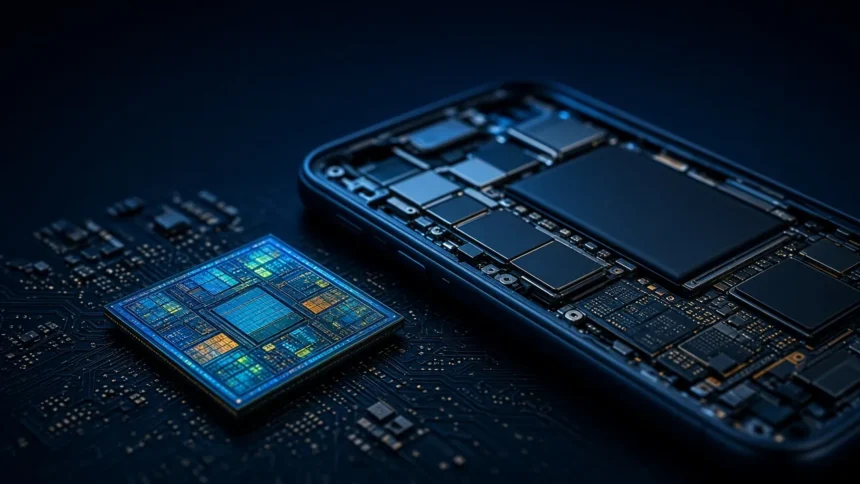
Snapdragon vs MediaTek is the wrong first question. The tier and the year of the chip matter more than the brand: a 2026 MediaTek Dimensity 9600 Pro sits in a different class from a late-2022 Snapdragon 8 Gen 2, and a Snapdragon 4-series chip is a budget part whatever the logo says.
Samsung’s Exynos and Google’s Tensor follow the same rule. Check the series number first, then the phone’s cooling and update promise.
Key takeaway
- Series beats brand: Snapdragon 8 and Dimensity 9000 are flagship tiers, Snapdragon 7 and Dimensity 8000 are upper mid-range, and Snapdragon 4 or Dimensity 6000 are budget.
- Newer usually wins within a tier: the 2026 flagships from Qualcomm, MediaTek and Samsung are all 2nm chips. A three-year-old flagship chip is a used-phone bargain, not a new-phone benchmark.
- Gaming and heat depend on the phone: the same chip runs cooler and holds speed longer in a phone with a bigger vapour chamber.
- Updates come from the phone maker: Google promises seven years for Pixel 11, and Samsung offers seven OS upgrades on its Galaxy S flagships. The chip brand sets a ceiling, not a promise.
- Before you buy: look up the exact chip model, the update policy and a review that tested sustained gaming on that phone.
What a phone chip is, and why the brand name misleads
A phone chip is a system-on-chip (SoC): CPU cores, graphics, an AI processor (NPU), the camera image processor and usually the 5G modem on one piece of silicon. Qualcomm (Snapdragon), MediaTek (Dimensity) and Samsung (Exynos) sell chips to phone makers. Google designs Tensor only for its own Pixel phones.
Qualcomm and MediaTek sell chips for everything from entry-level phones to ₹1 lakh-plus flagships. A Snapdragon 4-series phone and a Snapdragon 8 Elite phone share a logo and very little else, so “Snapdragon phone” on a listing tells you almost nothing.
Snapdragon vs MediaTek: how the four chip brands line up
| Brand | Flagship tier | Upper mid-range | Budget | Where you’ll see it in India |
|---|---|---|---|---|
| Qualcomm Snapdragon | 8 Elite, 8 series | 8s, 7 series | 6 and 4 series | OnePlus, Samsung Galaxy S Ultra, iQOO, Motorola, Xiaomi and many others |
| MediaTek Dimensity | 9000 series | 8000 series | 7000 and 6000 series | Budget and mid-range phones from most brands, plus some flagships |
| Samsung Exynos | 2000 series (Exynos 2600) | 1000-series (Exynos 1580 and similar) | Lower 1000 series | Samsung only: Galaxy S26, S26+, FE and A-series |
| Google Tensor | Tensor G6 | None | None | Pixel phones only |
The current flagship chips compared
All four brands launched or shipped a new top chip in 2026. These specs come from each company’s own pages, and the performance claims are theirs, not our measurements.
| Chip | Announced | Process | CPU layout | Maker’s headline claim |
|---|---|---|---|---|
| Snapdragon 8 Elite Gen 6 | September 2026 | 2nm | 8 Oryon cores: 2 up to 5.0GHz, 6 up to 4.0GHz | The Extreme Gen 6 version claims 44% faster graphics than 8 Elite Gen 5 |
| MediaTek Dimensity 9600 Pro | September 2026 | 2nm | 8 cores: 2 Arm C2-Ultra, 6 Arm C2-Pro | 17% faster single-core CPU than the previous generation |
| Samsung Exynos 2600 | Shipping in Galaxy S26 (2026) | 2nm GAA | 10 cores: 1 Arm C1-Ultra, 9 Arm C1-Pro | Up to 39% faster CPU and twice the GPU compute of Exynos 2500 |
| Google Tensor G6 | August 2026 (Pixel 11) | Made by TSMC | Not detailed by Google | 25% faster web browsing and 15% quicker app launches than Tensor G5 |
The Snapdragon 8 Elite Gen 6 chips are only starting to reach phones, so many flagships on sale in India today still run last year’s Snapdragon 8 Elite Gen 5. That includes the OnePlus 15 and the Galaxy S26 Ultra, while the Galaxy S26 and S26+ sold in India use the Exynos 2600.
💡 Expert tip: Samsung often splits chips by model and by country. In India the Galaxy S26 Ultra uses Snapdragon and the S26 uses Exynos, so read the spec sheet for the exact model you’re buying.
Why a new Dimensity can beat an older Snapdragon
Each generation brings newer CPU cores, a faster GPU and a more efficient manufacturing process. The Snapdragon 8 Gen 2 launched in late 2022 on a 4nm process with older Arm cores. The Dimensity 9600 Pro is a 2nm chip with Arm’s 2026 C2 cores, LPDDR6 memory support and UFS 5.0 storage support.
Three generations of yearly gains add up, so a current Dimensity 9000-series phone should comfortably outpace an 8 Gen 2 phone in CPU and graphics work. The same logic runs the other way: a 2026 Snapdragon 8 Elite Gen 6 phone will outpace a 2023 Dimensity flagship. Compare chips of the same year and tier, and the brand gap narrows to strengths in specific areas.
That’s why an older flagship can still be a good buy at the right price. Our guide to phones with the Snapdragon 8 Gen 2 covers when that trade makes sense.
What affects gaming performance
- The GPU tier. Flagship Adreno, Mali and Xclipse GPUs handle the heaviest games at high settings. Budget 4-series and Dimensity 6000-series chips are built for lighter games and lower settings.
- Sustained speed, not peak. A phone can post a high score in a short benchmark and then slow down after 15 minutes of play. Reviews that run a long stress test tell you more than a single score.
- Game support. Some games offer high-frame-rate modes only on phones the developer has approved, so a fast chip doesn’t guarantee 120fps in every title.
- Upscaling and frame generation. Qualcomm, MediaTek and Samsung now build AI upscaling into their newest flagship chips (Samsung calls its version ENSS), but games have to support it.
What affects heat and battery life
Efficiency comes from the chip’s process and design, and all of 2026’s flagship chips use 2nm-class manufacturing. Heat that reaches your hand also depends on the phone. Samsung says the Galaxy S26 uses a larger vapour chamber, and Samsung Semiconductor added a Heat Path Block to the Exynos 2600 package to move heat out faster.
In practice, a thin flagship can run hotter and throttle sooner than a thicker mid-range phone with a big battery. Indian summers make that worse. If you game for long sessions, look for reviews that report temperatures and sustained performance for that exact model.
What affects software updates
Update length is a phone maker decision. Google promises seven years of OS, security and Pixel Drop updates for the Pixel 11 series, and Samsung has offered seven generations of OS upgrades on Galaxy S flagships since the Galaxy S24.
The chip maker sets how long it will support its drivers. Qualcomm and Google announced in 2025 that phones with Snapdragon 8 Elite and later 8 and 7-series chips can get up to eight years of Android updates, but only if the phone maker chooses to offer them. MediaTek-powered phones get the update policy the brand publishes, so check the brand’s policy page before buying.
⚠️ Watch out for: budget phones that list “2 years of updates” in small print. A cheap chip plus a short update policy is where the hidden costs of a cheap smartphone show up first.
Which chip should you pick?
Best for most buyers: a current upper mid-range chip, such as a Snapdragon 7-series or 8s-series, or a Dimensity 8000-series, in a phone with at least four years of promised updates. That covers daily use, photos and most games.
Best for heavy gaming: a 2025 or 2026 flagship chip (Snapdragon 8 Elite Gen 5 or Gen 6, Dimensity 9500 or 9600 series) in a phone with good cooling.
Best for long updates and clean software: a Pixel with Tensor, or a Galaxy S model. Tensor phones trade some raw gaming speed for Google’s AI features and seven years of updates.
Not ideal for: paying flagship prices for a two-year-old flagship chip at launch price. Wait for the discount or buy the newer chip.
Common mistakes
- Choosing on brand alone. “Snapdragon” on a ₹12,000 phone means a budget chip.
- Comparing chips from different years. Line up the launch years before you compare.
- Trusting one benchmark score. Sustained performance and thermals matter more for gaming.
- Ignoring the update policy. A fast chip with two years of updates ages faster than a slower one with six.
- Forgetting the charger and battery. Chip efficiency helps, but battery size and how fast charging works shape daily battery life too.
What to buy
Our best Samsung phones guide flags which models use Exynos and which use Snapdragon in India. The best OnePlus phones list runs from Dimensity-powered budget models to Snapdragon 8 Elite Gen 5 flagships.
If you care most about photos, our best camera phones list matters more than the chip. Considering a Pixel? See every Google phone in order to work out which Tensor generation you’re getting.
How we researched this
This explainer is research-based, not hands-on tested. Chip specs come from Qualcomm’s Snapdragon 8 Elite Gen 6 product brief, MediaTek’s Dimensity 9600 Pro page, Samsung Semiconductor’s Exynos 2600 page and Google’s Pixel 11 announcement. The update support detail comes from Qualcomm’s update support announcement. Performance figures are each company’s own claims; we haven’t benchmarked these chips. Last checked: 24 November 2026.
Frequently asked questions
Snapdragon vs MediaTek: which is better?
Neither brand is better across the board. Compare chips of the same tier and year: a Snapdragon 8 Elite Gen 6 and a Dimensity 9600 Pro are both 2026 flagship chips, while a Snapdragon 4-series is a budget part. The phone’s cooling, software and update policy decide more than the logo.
Is MediaTek good for gaming?
Yes, at the right tier. MediaTek’s Dimensity 9000-series flagship chips are built for demanding games, and the 8000 series handles most titles well. Budget Dimensity 6000 chips suit lighter games. Check a review that tests sustained gaming on the exact phone, since cooling changes results.
Do MediaTek phones overheat more than Snapdragon phones?
Not as a rule. Heat depends on the specific chip, its manufacturing process and the phone’s cooling system. A well-cooled Dimensity phone can run cooler than a thin Snapdragon phone. Older chips on less efficient processes tend to run warmer than 2026’s 2nm chips.
Is Exynos worse than Snapdragon?
Earlier Exynos chips had a reputation for running hotter, but the Exynos 2600 is a 2nm chip with ten cores and a new heat-spreading package. Samsung uses it in the Galaxy S26 and S26+ in India. Read reviews of the exact model, since Samsung sells Snapdragon and Exynos versions by country.
Is Google Tensor good for gaming?
Tensor chips focus on AI, photos and Google features more than peak gaming speed. They run popular games well, but a Snapdragon 8 Elite or Dimensity 9000-series phone is the safer pick if long, high-setting gaming sessions are your priority. Pixel 11 adds seven years of updates.
Does the chip brand affect software updates?
Only indirectly. The phone maker decides the update policy. Chip makers decide how long they support drivers: Qualcomm says Snapdragon 8 Elite and later 8 and 7-series phones can get up to eight years, if the brand chooses. Always check the phone maker’s published policy.
Is a Snapdragon 8 Gen 2 phone still worth buying?
At a used or heavily discounted price, it can be. It’s a 2022 flagship chip that still handles daily use and most games. A new mid-range phone may get longer updates and a bigger battery, so compare the remaining update years before paying.
Which chip is best for a phone under ₹30,000?
Look for a recent Snapdragon 7-series or Dimensity 7000 or 8000-series chip from the last year or two. At this price the update policy, battery and screen often matter more than which of the two brands made the chip. Avoid older 4G-only chips.
Our verdict
In the Snapdragon vs MediaTek debate, the logo is the last thing to check. Pick the newest chip in the tier you can afford, then judge the phone on cooling, battery and the number of update years in writing.
For heavy gaming, buy a current flagship chip from either brand. For long-term use, a Pixel or Galaxy S phone with seven years of updates holds value better. Before you pay, confirm the exact chip on the spec sheet and read one review that tested the phone for sustained heat.