


Ask Firecrawl for a web page as clean Markdown and it costs 1 credit. Ask for the same page as structured JSON and it costs 5. If you plan to pull structured data out of websites, that difference matters more than which plan you pick.
Firecrawl pricing starts with a free plan of 1,000 credits a month, and paid plans run from $16 a month (about ₹1,500) on yearly billing. Below, we translate every plan into pages and rupees, and show the point where upgrading starts to save you money.
🔎 How we know: this is a research-based guide. We checked Firecrawl’s pricing page and billing documentation on 13 October 2026 and didn’t run paid jobs ourselves (details at the end). Techlude has no affiliate deal with Firecrawl, so we earn nothing if you sign up.
⚡ Quick Verdict
- Best for most teams: Standard, $83 a month on yearly billing for 100,000 credits. It’s the cheapest way to buy credits until you need a lot more than that.
- Best for side projects: Hobby, $16 a month on yearly billing for 5,000 credits, plus top-ups if you go over.
- Free plan: 1,000 credits every month with no card. Enough to prototype, not enough to run a product.
- Skip the paid plans if: you can run your own servers and don’t need Firecrawl’s anti-bot engine. Self-hosted Firecrawl and Crawl4AI cost nothing but your time.
Firecrawl pricing at a glance (October 2026)
Firecrawl has five self-serve plans and a custom Enterprise tier. These prices took effect on 4 September 2026, and you pay in US dollars. The rupee column is what Firecrawl’s pricing page showed us from India for yearly billing.
| Plan | Monthly billing | Yearly billing (per month) | Credits a month | Concurrent browsers | ≈ ₹ a month (yearly) |
|---|---|---|---|---|---|
| Free | $0 | $0 | 1,000 | 2 | ₹0 |
| Hobby | $19 | $16 | 5,000 | 5 | ₹1,500 |
| Standard | $99 | $83 | 100,000 | 25 | ₹7,900 |
| Growth | $399 | $333 | 500,000 | 50 | ₹31,700 |
| Scale | $749 | $599 | 1,000,000 | 100 | ₹57,000 |
| Enterprise | Custom | Custom | Custom | Custom | Custom |
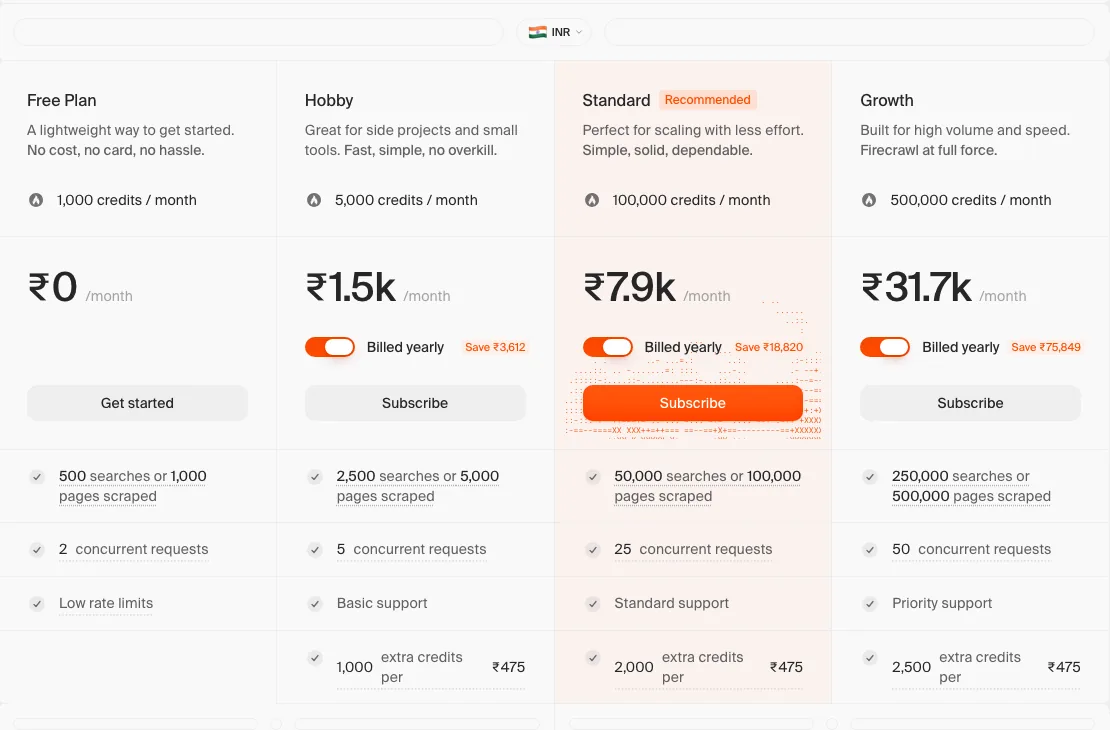
Yearly billing saves 16.7% on Hobby, Standard and Growth, and 20% on Scale. Even on a yearly plan, your credits still reset every month, so paying yearly doesn’t hand you a year’s credits upfront.
If another guide quotes a free plan of 500 one-time credits or a Hobby plan with 3,000 credits, it’s using Firecrawl’s older pricing. The current plans give you 1,000 free credits every month and 5,000 on Hobby.
What one Firecrawl credit actually buys
Every plan draws on a single credit balance, and each feature costs the same number of credits on every plan. Here’s how the main actions are charged, in plain English, according to Firecrawl’s billing documentation.
| What you ask Firecrawl to do | Credits | What it means for you |
|---|---|---|
| Scrape one page as Markdown or HTML | 1 per page | The basic unit. 1,000 credits means about 1,000 pages. |
| Crawl a whole site | 1 per page | Same as scraping, page by page. Set a page limit, or a crawl can run to 10,000 pages. |
| Map a site’s URLs | 1 per request | Lists a site’s pages without reading them. Cheap and quick. |
| Search the web | 2 per 10 results | Rounded up, so 11 results cost 4 credits. Scraping the results adds the page costs. |
| Get structured JSON, an AI answer or highlights | +4 per page | A JSON scrape costs 5 credits, five times a plain page. |
| Redact personal data from the output | +4 per page | Stacks with JSON: JSON plus redaction is 9 credits a page. |
| Interact (a live browser session) | 2 or 7 per minute | 2 when you send your own browser code, 7 when an AI prompt drives it. One-minute minimum. |
| Monitor a page for changes | 1 per page, per check | Handy for price or stock tracking. Checks that extract structured data cost 7 credits each. |
| Agent (autonomous research) | 5 free runs a day | After that, pricing depends on how much work the agent does, so it’s hard to predict. |
| X (Twitter) posts and threads | 30 per request | Handled through xAI’s Grok API, not regular scraping. |
| LinkedIn profiles and company pages | 5 to 40 per page | Routed to third-party data providers that set the price. |
Two details save real money. First, Firecrawl’s enhanced proxy, which helps with sites that block scrapers, costs no extra credits. Second, a request that returns nothing is free, but a page that comes back with an error such as 403 (blocked) or 404 (not found) still costs a credit, because Firecrawl did fetch something.
💡 Expert tip: before a big job, run a few test URLs with the exact formats you need, then check the credit usage in your Firecrawl dashboard. Multiply by your page count and you’ll know your monthly bill before it arrives.
How many pages each Firecrawl plan really covers
Credits make plans hard to compare, so here’s what each monthly allowance turns into for the three most common jobs, and what 1,000 plain pages cost on each plan.
| Plan | Markdown pages | JSON pages | Searches (10 results each) | Cost per 1,000 pages (monthly / yearly) |
|---|---|---|---|---|
| Free | 1,000 | 200 | 500 | $0 |
| Hobby | 5,000 | 1,000 | 2,500 | $3.80 / $3.20 |
| Standard | 100,000 | 20,000 | 50,000 | $0.99 / $0.83 |
| Growth | 500,000 | 100,000 | 250,000 | $0.80 / $0.67 |
| Scale | 1,000,000 | 200,000 | 500,000 | $0.75 / $0.60 |
The jump from Hobby to Standard is the big one. Hobby pays almost four times as much per page, which is fine for small tools and painful for anything that grows.
Pay-as-you-go: what extra Firecrawl credits cost
Paid plans can top up automatically when you run out. Firecrawl adds credits in $5 steps, and how many credits $5 buys depends on your plan. The free plan can’t top up: requests simply stop until the next monthly reset.
| Plan | Credits per $5 top-up | Cost per 1,000 extra credits | Overage headroom |
|---|---|---|---|
| Hobby | 1,000 | $5.00 (≈ ₹475) | 1,500 credits |
| Standard | 2,000 | $2.50 | 30,000 credits |
| Growth | 2,500 | $2.00 | 150,000 credits |
| Scale | 5,000 | $1.00 | 600,000 credits |
You set a monthly pay-as-you-go limit in whole $5 steps. Set it to zero and Firecrawl stops at your allowance; leave it blank and there’s no cap at all. The “overage headroom” keeps a burst of requests running while a top-up goes through. It isn’t extra credit you keep. Credits you buy stay on your account until you use them, but they expire if you cancel.
⚠️ Warning: a blank limit means unlimited top-ups. Set a monthly cap in your billing settings before you run a large crawl, especially on Hobby, where extra credits cost five times what they cost on Scale.
What changed on 4 September 2026
The plan prices didn’t move: an archived copy of the pricing page from August 2026 shows the same $16, $83, $333 and $599 yearly prices. What changed is how you buy extra credits. Firecrawl used to sell bigger auto-recharge packs (Scale paid $397 for an extra 350,000 credits, about $1.13 per 1,000). Now every paid plan tops up in $5 steps, and Scale pays $1 per 1,000.
When upgrading your Firecrawl plan starts to save money
Because top-ups on small plans are expensive, a bigger plan often costs less than a small plan plus top-ups. These are the break-even points, worked out from Firecrawl’s own prices:
| Move | Upgrade if you regularly use more than (monthly billing) | With yearly billing |
|---|---|---|
| Hobby → Standard | About 21,000 credits a month | About 18,000 |
| Standard → Growth | About 220,000 credits a month | About 200,000 |
| Growth → Scale | About 675,000 credits a month | About 630,000 |
Moving from Free to Hobby is less about price and more about limits. The free plan allows 10 scrape requests a minute and two pages at once. Hobby raises that to 100 a minute and five at once, and adds pay-as-you-go.
Bigger isn’t automatically better, though. If your usage swings a lot from month to month, a smaller plan with capped top-ups can beat paying for credits that expire. It’s the same lesson as with gadgets: the expensive option isn’t always the premium one.
Real jobs, priced
Here’s what four common projects would cost on the cheapest sensible setup, using basic Markdown scraping unless the job needs JSON.
| Job | Credits a month | Cheapest setup | Monthly cost |
|---|---|---|---|
| Price tracker: 200 product pages checked daily | 6,000 | Hobby + one $5 top-up | $24 (≈ ₹2,300) |
| Docs chatbot: a 3,000-page help centre re-crawled weekly | About 13,000 | Hobby + eight $5 top-ups | $59 (≈ ₹5,600) |
| Lead research: 10,000 company pages a month as JSON | 50,000 | Standard | $99 (≈ ₹9,400) |
| AI agent: 1,000 searches a day, scraping the top 3 results | About 150,000 | Standard + twenty-five $5 top-ups | $224 (≈ ₹21,300) |
The lead-research job shows the JSON effect clearly. On Hobby with top-ups, the same 50,000 credits would cost $244 a month, more than double Standard’s $99.
Firecrawl features by plan: what you get as you upgrade
Every plan can use every core endpoint: scrape, crawl, map, search, extract, batch scrape, interact and monitor. Upgrading buys speed, headroom and support rather than features.
| Feature | Free | Hobby | Standard | Growth | Scale |
|---|---|---|---|---|---|
| Concurrent browsers | 2 | 5 | 25 | 50 | 100 |
| Scrape, map and search requests per minute | 10 | 100 | 500 | 5,000 | 10,000 |
| Crawl and agent requests per minute | 2 | 20 | 100 | 1,000 | 2,000 |
| Pay-as-you-go top-ups | No | Yes | Yes | Yes | Yes |
| Unused credits roll over | No | No | No | No | One month on yearly billing |
| Support | Community | Basic | Standard | Priority + Slack | Priority + Slack |
Some things come with every plan, including the free one: SOC 2 Type II security audits, multi-factor sign-in, signed webhooks and optional removal of personal data from results. Single sign-on, zero data retention, IP-restricted API keys and fixed outgoing IP addresses are Enterprise-only.
The benefits: what you’re really paying Firecrawl for
- Output an AI can use straight away. You get clean Markdown or structured JSON instead of raw HTML, so there’s less cleanup before the text goes into a chatbot or a database.
- Hard pages handled for you. Firecrawl renders JavaScript-heavy pages and can switch to an enhanced proxy on difficult sites at no extra credit cost. Heavily protected sites can still block it.
- One API for the whole job. Search, scrape, crawl, map, monitor and browser sessions share one key and one credit balance, so there’s no stitching together of separate tools.
- Made for AI tools. Firecrawl has official SDKs and an MCP server, so assistants and coding tools that support MCP can call it directly.
- An exit if prices change. The core of Firecrawl is open source under the AGPL-3.0 licence, with more than 190,000 GitHub stars, so you can run it yourself if the cloud stops making sense.
Here’s the catch: costs that surprise new Firecrawl users
- Unused credits vanish. On Free, Hobby, Standard and Growth, your allowance resets every month. Only yearly Scale and Enterprise plans roll credits over.
- AI formats multiply the bill. JSON, AI answers, highlights and data redaction each add 4 credits a page, and they stack.
- Blocked pages still cost. A 403 or 404 page is returned and charged. Stop retrying URLs that keep failing.
- Crawls can run long. Without a page limit, a crawl can process up to 10,000 pages, and credits are billed as pages finish, sometimes hours later.
- Some sites cost far more. An X post costs 30 credits and a LinkedIn profile can cost up to 40.
- AI-driven browser sessions add up. Interact sessions run by an AI prompt cost 7 credits a minute, with a one-minute minimum even if the session fails.
- You pay in dollars. Firecrawl bills in US dollars and adds local tax at checkout, and Indian cards usually add a foreign-currency markup on top, so the rupee price you see is an estimate.
Is the Firecrawl free plan enough?
For learning and prototypes, yes. 1,000 credits a month covers about 1,000 pages, 500 searches or 200 JSON extractions, it renews every month, and you don’t need a card.
For anything live, no. The free plan allows only two pages at once and 10 scrape requests a minute, and when the credits run out your requests fail with an error until the next month. If real users depend on it, start at Hobby.
Firecrawl alternatives on a budget
| Option | Starting price | Best for | Watch out for |
|---|---|---|---|
| Firecrawl Cloud | Free, then $16 a month (yearly) | AI apps that want clean output without running servers | Credit multipliers on AI formats |
| Self-hosted Firecrawl | Free (AGPL-3.0) | Developers comfortable with Docker | No anti-bot engine, screenshots, agent or browser sessions; you run it all |
| Crawl4AI | Free (Apache-2.0) | Python developers who want full control | You handle proxies, scaling and any AI model costs |
| Apify | Free ($5 of usage a month), then $19 a month | Ready-made scrapers for specific sites | Each scraper is priced differently, so costs vary per job |
Self-hosting Firecrawl gives you the core scrape, crawl, map and search routes for free, but Firecrawl’s own docs say the anti-bot engine, screenshots, page actions, the agent and browser sessions aren’t included, and AI extraction needs a model provider you configure yourself. Crawl4AI is a popular open-source Python crawler built for AI pipelines. Apify is a marketplace of ready-made scrapers billed by usage, which suits jobs like scraping one specific shopping or maps site.
Which Firecrawl plan should you buy?
- Just learning or testing an idea: stay on Free. Upgrade only when you hit the monthly limit or the rate limit.
- A side project or personal AI tool: Hobby on yearly billing ($16 a month). Set a small pay-as-you-go cap so a busy month doesn’t surprise you.
- A product with real users, or any JSON extraction: Standard. Past about 21,000 credits a month it’s cheaper than Hobby with top-ups, and its top-ups cost half as much.
- Large data pipelines: Growth from about 220,000 credits a month, and Scale from about 675,000. Scale also rolls credits over on yearly billing and allows invoice billing.
- Compliance needs such as single sign-on or zero data retention: talk to Firecrawl about Enterprise.
- Tight budget and strong technical skills: try self-hosted Firecrawl or Crawl4AI before paying.
How we checked this guide
This guide is research-based, and we want to be clear about what that means. On 13 October 2026 we read Firecrawl’s pricing page (including its Markdown version), the billing documentation and the self-hosting guide, and compared them with an archived copy of the pricing page from 21 August 2026. Every cost example above is our own arithmetic from those prices.
We tried a free, no-key test scrape, but Firecrawl refused requests from our network without an API key, so this guide doesn’t include speed or success-rate tests. Read more about how we label our verdicts in our editorial standards, and see our affiliate disclosure for how Techlude makes money.
Frequently Asked Questions
Is Firecrawl free to use?
Yes. The free plan gives you 1,000 credits every month with no credit card, which covers about 1,000 scraped pages or 500 searches. It renews monthly, but it allows only two pages at once and stops working when the credits run out.
How much does Firecrawl cost per month?
Firecrawl pricing starts at $19 a month for Hobby, or $16 a month billed yearly, for 5,000 credits. Standard costs $99 a month ($83 yearly) for 100,000 credits, Growth $399 ($333) and Scale $749 ($599). Enterprise is custom.
How many pages can I scrape with Firecrawl credits?
One credit scrapes one page as Markdown, so 1,000 credits covers about 1,000 pages. If you ask for structured JSON, each page costs 5 credits, so the same 1,000 credits covers only about 200 pages.
Do unused Firecrawl credits roll over?
Usually not. Free, Hobby, Standard and Growth credits reset every month, even on yearly billing. Yearly Scale plans roll unused credits over for one month and yearly Enterprise plans for two. Credits you buy as top-ups stay until you use them or cancel.
Does Firecrawl charge for failed requests?
It depends on what comes back. A scrape that returns nothing costs nothing. A page that returns an error such as 403 or 404 still costs 1 credit, because Firecrawl fetched it and gives you the response.
What happens when I run out of Firecrawl credits?
On the free plan, requests stop with an error until your monthly reset. On paid plans, Firecrawl can top up automatically in $5 steps until it reaches the monthly limit you set. With pay-as-you-go turned off, requests stop instead.
Can I pay for Firecrawl in Indian rupees?
Not directly. Firecrawl bills every invoice in US dollars. Its pricing page shows rupee estimates, such as about ₹1,500 a month for Hobby on yearly billing, but your bank’s conversion rate, its forex markup and local taxes decide the final amount.
Is self-hosted Firecrawl free?
Yes. Firecrawl’s core is open source under the AGPL-3.0 licence, so self-hosting costs nothing except servers and your time. The self-hosted version lacks the cloud’s anti-bot engine, screenshots, agent and browser sessions, and AI extraction needs your own model provider.
Which Firecrawl plan is best value?
Standard is the best value for most teams. It costs $0.99 per 1,000 pages on monthly billing against $3.80 on Hobby, and it beats Hobby with top-ups once you use more than about 21,000 credits a month.
Final verdict on Firecrawl pricing
Firecrawl pricing is fair once you know where the credits go. For most teams, Standard is the plan to buy: $83 a month on yearly billing gets 100,000 credits, and it stays cheaper than Hobby with top-ups for almost any real product. Hobby suits small personal tools, and the free plan is a genuinely useful sandbox.
The honest warning is about multipliers rather than plan prices. JSON extraction, AI answers and data redaction can multiply your credit use by five or more, and an uncapped pay-as-you-go setting will keep charging your card. Start on the free plan, measure what your real jobs cost, set a monthly cap, then pick the plan from the break-even table above.