

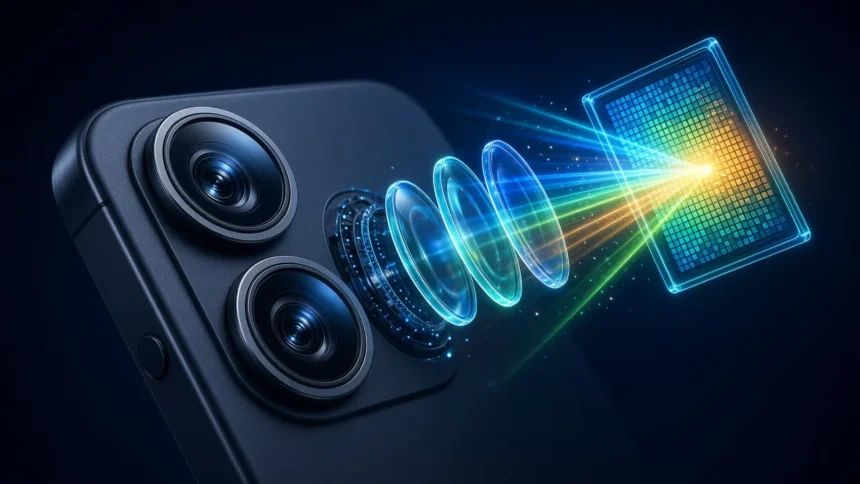
Sensor size matters more than megapixels for phone camera quality, especially at night. A bigger sensor collects more light in the same exposure, which means less noise, better colour and more detail in shadows. Megapixels only decide how many pieces that light is split into.
That’s why a 200MP camera is mostly a marketing number: most 200MP phones merge pixels and save 12MP to 50MP photos by default. Lens quality and processing decide the rest.
Key takeaway
- Megapixels count the light-sensing pixels on the sensor. More of them help detail in bright light and cropping.
- Sensor size is the physical area catching light. It drives low-light quality, dynamic range and natural background blur.
- Pixel binning merges groups of small pixels into one bigger pixel, so a 200MP sensor can shoot 50MP or 12.5MP photos with less noise.
- What to check: sensor size (like 1/1.3-inch), aperture, OIS and the phone’s processing track record before the megapixel badge.
Megapixels vs sensor size: what each number means
A camera sensor is a grid of tiny light-sensing pixels (also called photosites). Megapixels tell you how many there are: 50MP means about 50 million. Sensor size tells you how big the whole grid is. Pixel size, in micrometres (µm), is the result of fitting one into the other.
The same sensor area can hold 50 million larger pixels or 200 million smaller ones. More pixels on the same area means each one is smaller and catches less light on its own.
| Sensor | Megapixels | Sensor size (optical format) | Pixel size |
|---|---|---|---|
| Samsung ISOCELL HP2 | 200MP | 1/1.3-inch | 0.6µm |
| Sony LYTIA 901 | 200MP | 1/1.12-inch | 0.7µm |
| Sony LYTIA 900 | 50MP | 1/0.98-inch (1-inch type) | 1.6µm |
| Google Pixel 11 Pro main camera | 50MP | 1/1.3-inch | Not listed |
| Google Pixel 11 Pro ultrawide | 48MP | 1/2.51-inch | Not listed |
Compare the first and third rows. The 200MP HP2 has 0.6µm pixels against the 50MP LYTIA 900’s 1.6µm, so each HP2 pixel has about a seventh of the area (0.36 vs 2.56 square micrometres). Working from the pixel counts and sizes, the LYTIA 900’s whole sensor is roughly 1.8 times the area of the HP2.
Why sensor size decides low-light photos
Light is the raw material of a photo. At the same shutter speed and aperture, a sensor with more area receives more light. More light means a cleaner signal, so the phone needs less amplification and less noise reduction.
A small sensor in a dim room has two bad options. It can use a longer exposure, which blurs anything that moves, including your hand. Or it can boost the signal, which adds grain that the phone then smooths away. That smoothing is the waxy, watercolour look in many budget phone night shots.
Google’s Pixel 11 Pro spec page shows this inside one phone. The 50MP main camera uses a 1/1.3-inch sensor, while the 48MP ultrawide uses a 1/2.51-inch one. Going by those nominal sizes, the ultrawide sensor has roughly a quarter of the area.
Similar megapixels, very different night photos: that is why ultrawide shots on most phones fall apart first when light drops.
✅ Best for low light: phones with a main sensor of 1/1.3-inch or larger, a wide aperture (a smaller f-number, such as f/1.7) and optical image stabilisation. Those three specs tell you more than the megapixel count.
How to read sensor sizes like 1/1.3-inch
Phone sensor sizes use an old naming system borrowed from video camera tubes. The fraction is not the real diagonal. Sony lists its LYTIA 900 as a 1/0.98-type sensor with a 16.384 mm diagonal; a true 1/0.98 inch would be about 26 mm.
Two rules make the numbers usable:
- A smaller number under the 1 is a bigger sensor. 1/1.3-inch is bigger than 1/1.56-inch, which is bigger than 1/2.51-inch.
- “1-inch type” is the top of the phone range. A handful of camera-focused flagships use one.
- The format is for comparison, not maths. Use it to rank sensors against each other, not to work out exact areas.
How pixel binning works
Pixel binning is how high-megapixel phones get around their tiny pixels. The sensor groups neighbouring pixels and combines their signals into one bigger “super pixel”. A 2 by 2 group gives 4-in-1 binning. A 4 by 4 group gives 16-in-1.

Samsung’s ISOCELL HP2 announcement shows the maths. The 200MP sensor packs 0.6µm pixels into a 1/1.3-inch format. In dim light it turns into a 50MP sensor with 1.2µm pixels by binning four pixels, or a 12.5MP sensor with 2.4µm pixels by binning 16.
Samsung notes that 1/1.3-inch is a size widely used in 108MP phone cameras, so the extra resolution comes without a bigger camera bump.
Binning doesn’t create light. The sensor still catches the same total amount. It trades resolution for a cleaner signal per output pixel, so a binned 12.5MP shot from a 1/1.3-inch sensor behaves much like a native 12.5MP sensor of the same size. That’s why Sony’s 1-inch-type LYTIA 900 can beat a 200MP sensor at night with only 50MP.
💡 Expert tip: the full 200MP or 50MP mode is usually a separate setting. Google lists High-Res photos up to 50MP as a camera feature on the Pixel 11 Pro. Use it in bright daylight when you plan to crop or print large, and leave it off at night.
When more megapixels help
Megapixels aren’t useless. They help in three situations.
- Bright light: with plenty of light, small pixels get enough signal and a full-resolution shot holds more fine detail, such as leaves or text on a distant sign.
- Cropping and zoom: a high-resolution sensor can crop its centre for a sharp zoom. Apple’s iPhone 18 Pro spec sheet lists a 12MP “optical-quality” 2x option from its 48MP main camera. Some phones now use 200MP telephoto cameras to crop further, which our best camera phones guide covers.
- Video: 8K video needs about 33MP, so a sensor with more pixels can record it with less cropping. Samsung’s HP2 uses its 50MP binned mode for 8K.
The cost is storage. Full-resolution photos are several times larger than binned ones, which fills a 128GB phone and your cloud storage backup faster.
Lens and processing matter as much as the sensor
A big sensor behind a poor lens still gives a soft photo. Three things around the sensor decide the final image.
- Aperture: the f-number tells you how wide the lens opens. f/1.7 lets in about 2.7 times as much light as f/2.8. Apple’s iPhone 18 Pro main camera has a variable aperture from f/1.48 to f/4.0, which lets it trade light for depth of field.
- Stabilisation: optical image stabilisation (OIS) lets the camera hold a longer exposure without blur, which adds light without adding noise.
- Processing: phones shoot several frames, align them and merge them. Multi-frame processing is a big reason Pixels and iPhones get strong results without the largest sensors. The image signal processor in the chip does this work; our phone chip explainer covers how chips differ.
Processing also changes between generations of the same phone. Our timelines of Google Pixel phones in order and every iPhone in order show when each brand changed its camera hardware.
Phone camera megapixels vs sensor size: what to check before buying
| Spec | Where to find it | What to look for |
|---|---|---|
| Main sensor size | Detailed spec page, not the box | 1/1.56-inch or bigger for mid-range; 1/1.3-inch or bigger for flagships |
| Aperture | Spec page, as f/1.x | Smaller number, such as f/1.6 to f/1.9 |
| OIS | Spec page | OIS on the main camera, and on the telephoto if zoom matters |
| Ultrawide and telephoto sensor size | Often missing | Bigger helps night shots on those lenses |
| Megapixels | The box | Treat as a tie-breaker, not a headline |
| Sample photos at night | Reviews with full-size samples | Clean shadows, natural skin tones, no smearing |
Common mistakes
- Buying the 108MP or 200MP badge on a budget phone. A high pixel count on a small sensor with basic processing often loses to a 50MP flagship camera. Our list of the hidden costs of cheap smartphones covers other traps in this segment.
- Judging cameras by daylight samples. Almost every phone looks good in sunlight. Compare indoor and night photos.
- Comparing megapixels across lenses. A 48MP ultrawide on a small sensor won’t match a 48MP main camera.
- Shooting everything at full resolution. You get bigger files and more noise in dim light, with little visible gain on a phone screen.
What to buy
If camera quality is your top priority, start with the best camera phones guide linked above: it picks phones by job, from point-and-shoot to zoom and video. For Galaxy buyers, our Samsung phones to buy list shows which models get the bigger main sensors and telephotos.
On a budget, pick the phone with the larger main sensor and OIS over the one with more megapixels. Then check night samples in a review before you pay.
How we researched this
This is a research-based explainer. Sensor specs come from Samsung’s ISOCELL HP2 announcement, Sony’s mobile image sensor lineup, and Google’s and Apple’s official spec pages. Area comparisons are our own arithmetic from published pixel counts and sizes. We did not shoot test photos for this article. Last checked: November 2026.
Frequently asked questions
Is sensor size more important than megapixels on a phone?
Yes, for most photos. Sensor size sets how much light the camera collects, which drives noise, dynamic range and night quality. Megapixels decide how finely that light is divided. A 50MP camera on a large sensor usually beats a 200MP camera on a smaller one, especially indoors and at night.
Is a 200MP camera better than 50MP?
Not by itself. A 200MP sensor uses very small pixels and normally bins them to save 12.5MP or 50MP photos. It helps for daylight detail and cropping. Low-light quality depends on sensor size, the lens and processing, so a good 50MP main camera can produce better photos overall.
What does 1/1.3-inch sensor size mean?
It is an optical format name inherited from old video camera tubes, not the real diagonal. A smaller number after the slash means a bigger sensor, so 1/1.3-inch beats 1/1.56-inch. Use the figure to compare phones; Sony’s 1/0.98-type sensor, for example, measures 16.4 mm diagonally.
What is pixel binning on a phone camera?
Pixel binning combines groups of neighbouring pixels into one larger pixel. Four-in-one binning turns a 200MP sensor into 50MP, and 16-in-one turns it into 12.5MP. The output has fewer pixels but a cleaner signal in each one, which cuts noise in dim light.
Should I shoot in 50MP or 200MP mode?
Use full resolution only in good light when you plan to crop or print large. In dim light, the binned default gives cleaner photos and much smaller files. On a phone screen or social media you will rarely see the extra detail, so leave the default on for everyday shots.
Why are my ultrawide photos worse at night?
Ultrawide cameras usually have much smaller sensors and narrower apertures than the main camera. On the Pixel 11 Pro, for example, the ultrawide sensor is 1/2.51-inch against 1/1.3-inch for the main camera. Less light reaches it, so night shots show more noise and smearing.
Does a bigger sensor give better portrait blur?
Yes. At the same framing and aperture, a larger sensor gives a shallower depth of field, so backgrounds blur more naturally. Phone sensors are still small, so most portrait blur comes from software. A bigger main sensor makes that blur look less artificial around hair and edges.
How do I find a phone’s camera sensor size?
Check the full spec page on the maker’s website, not the box. Google lists image sensor size for each Pixel camera. Some brands only name the sensor model, such as ISOCELL HP2 or LYTIA 900, so search the sensor maker’s page for its optical format.
Our verdict
When phone camera megapixels and sensor size point different ways, trust the sensor size. A large main sensor with a bright lens, OIS and good processing makes better photos than a bigger megapixel number, and the gap is widest at night.
Treat 200MP as a zoom and cropping feature, not a quality score. Before you buy, find the main sensor size on the spec page and look at real night samples.