
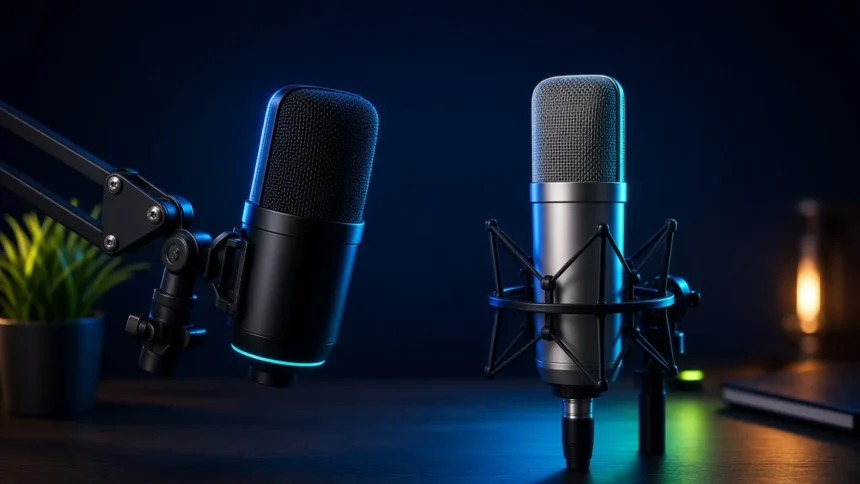
In a dynamic vs condenser microphone choice for a normal Indian bedroom, the dynamic mic usually wins. It needs your mouth a few centimetres away and picks up far less of the ceiling fan, the traffic and the echo off bare walls.
A condenser captures more detail, and that includes every one of those noises. It earns its price only in a quiet room softened with curtains, a bed and a rug.
Key takeaway
- Your room decides first: a noisy or echoey room favours a dynamic mic. A quiet, furnished room lets a condenser show its extra detail.
- Dynamic mics: less sensitive, need no power, shrug off loud sources and humidity, and sound best 3-10 cm from your mouth.
- Condenser mics: more sensitive, crisper highs, need phantom or USB power, and hear the whole room.
- USB or XLR is a separate question: both mic types come in both versions.
- Before you buy: record 30 seconds on your phone with the fan on. If the hum and echo are loud, buy a dynamic.
How dynamic and condenser microphones work
A dynamic microphone works like a tiny speaker in reverse. Sound moves a diaphragm attached to a coil of wire sitting in a magnet’s field, and that movement generates the signal. There’s no electronics to power, which is why dynamics like the Shure SM58 survive years of stage abuse.
A condenser microphone uses a very thin diaphragm next to a charged metal backplate. When sound moves the diaphragm, the gap changes and so does the signal. The diaphragm is lighter than a dynamic’s coil assembly, so it reacts to quieter sounds and finer high-frequency detail. The trade-off: it needs power, either 12-48V phantom power from an interface or mixer, or power from the USB port on a USB mic.
Dynamic vs condenser microphone: side-by-side
| Factor | Dynamic mic | Condenser mic |
|---|---|---|
| How it makes a signal | Diaphragm, coil and magnet | Charged diaphragm and backplate |
| Power needed | None | Phantom power (12-48V) or USB power |
| Sensitivity | Lower: hears mostly what’s close | Higher: hears quiet and distant sounds too |
| Room noise and echo | Picks up less | Picks up more |
| High-frequency detail | Smoother, slightly softer top end | Crisper, more airy |
| Loud sources | Very hard to overload | Has a maximum level; most handle voice easily |
| Heat and humidity | Tolerant | More sensitive to extremes |
| Best mouth distance | About 3-10 cm | About 15-30 cm |
| Typical use | Podcasts, streaming, live vocals, untreated rooms | Studio vocals, acoustic instruments, quiet treated rooms |
Why your room matters more than the mic
Most Indian bedrooms are hard on microphones: tiled or marble floors, bare plaster walls, a ceiling fan running all day and a road outside. A condenser hears all of it. Shure’s own podcasting guide warns that condensers can pick up too much “shhh” from air vents and mouth noise at home, while dynamics naturally mask it.
Distance is the bigger reason. Every time you double the gap between your mouth and the mic, your voice drops by about 6 dB while the room noise stays the same. A dynamic is used close, so your voice dominates. A condenser placed 20-30 cm away records a lot more fan and echo along with you.
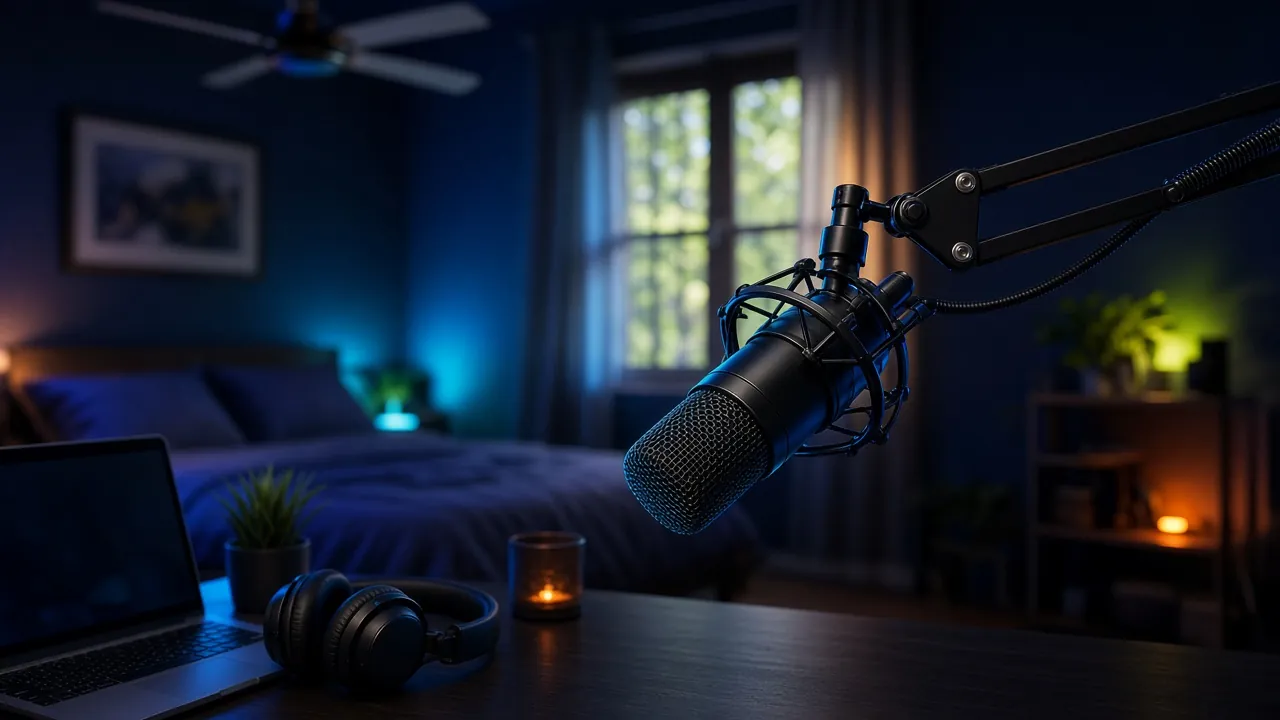
💡 Expert tip: try the clap test. Stand where you’ll record and clap once. If you hear a ring or flutter after the clap, your room has echo, and a dynamic mic used close will sound better than a condenser.
When a dynamic mic is the better pick
Best for: podcasts and streams recorded in a bedroom or shared flat, gaming with a fan or AC running, live singing, loud voices and anyone who records with family noise in the background.
Not ideal for: soft acoustic guitar, recording a group around one mic, or speakers who move around and can’t stay close to the grille.
Watch out for: gain. Many XLR dynamics have low output and need a lot of preamp gain, and cheap interfaces add hiss when turned up high. Shure’s SM7dB adds a built-in preamp for this reason. USB dynamics, such as the Shure MV7+, handle gain internally.
When a condenser mic is the better pick
Best for: singers and voice-over artists in a quiet, furnished room, acoustic instruments, ASMR and anyone who wants the most detailed, open sound and can control the noise around them.
Not ideal for: rooms with a ceiling fan you can’t switch off, flats on a busy road, or streamers whose keyboard sits next to the mic.
Watch out for: power and humidity. An XLR condenser needs an interface with 48V phantom power, and long humid monsoon spells are harder on condensers than on dynamics, so store it in a dry, covered place.
⚠️ Watch out for: a condenser does not hide a bad room. Turning the gain down only lowers your voice and the noise together. Fix the room or move the mic closer before you blame the mic.
USB or XLR is a separate choice
Dynamic and condenser describe how the capsule works. USB and XLR describe how it connects. You can buy a USB condenser (the RØDE NT-USB+), a USB dynamic (the Audio-Technica AT2040USB), an XLR condenser (the Audio-Technica AT2020) or an XLR dynamic (the Shure SM58). Some, like the Shure MV7+, offer both connections.
USB is the simplest start: plug into a laptop and record. XLR needs an interface but lets you upgrade the mic and the preamp separately. Our guide to audio interfaces for home studios covers which ones supply phantom power and enough gain.
Common mistakes
- Buying a condenser because it looks “professional”. In an echoey room it often sounds worse than a cheaper dynamic.
- Using a dynamic too far away. At arm’s length a dynamic sounds thin and quiet. Keep it within a hand’s width of your mouth.
- Pointing the mic at the fan or window. Aim the back of a cardioid mic, its quietest side, toward the noise.
- Forgetting phantom power. An XLR condenser stays silent until 48V is switched on.
- Skipping a pop filter or windscreen. Close-up dynamics and sensitive condensers both pop on hard “p” and “b” sounds.
- Spending on the mic before the room. A thick curtain, a rug and a bookshelf can do more for your recordings than a mic upgrade.
What to buy
For talking, our best microphones for podcasting guide leans toward dynamics like the Shure MV7+ and SM7dB for home rooms, with the RØDE NT-USB+ as the condenser option. Streamers should check our best microphones for streaming, which covers USB condensers such as the HyperX QuadCast 2 S and the SM7dB for broadcast sound.
Singers can start with our microphones for singing list, which splits stage dynamics like the SM58 from home condensers like the RØDE NT1. For studio-style vocals, see microphones for vocal recording. If you’re on camera too, pair the mic with one of our webcams for meetings and streaming.
How we researched this
This explainer is research-based, not a hands-on test. How each mic type works comes from Shure’s guides to how microphone transducers work and choosing a microphone for podcasting, plus maker spec sheets for the models named. Last checked: November 2026.
Frequently asked questions
Dynamic vs condenser microphone: which is better for a home studio?
It depends on the room. In an untreated bedroom with a fan or traffic, a dynamic mic usually sounds cleaner because it picks up less room noise. In a quiet room with curtains, a rug and soft furniture, a condenser gives more detail and a more open sound.
Is a dynamic or condenser mic better for podcasting?
For most home podcasters a dynamic mic is the safer choice. You speak close to it, so your voice stays loud while echo and fan noise stay low. Condensers suit podcasters with a quiet, treated room who want a brighter, more detailed sound.
Which is better for singing, dynamic or condenser?
On stage, dynamics like the Shure SM58 are the standard because they resist feedback and rough handling. For recording vocals at home, a condenser captures more detail, but only if the room is quiet and not echoey. In a noisy room, a dynamic records cleaner vocals.
Do dynamic microphones need phantom power?
No. A passive dynamic mic generates its own signal and needs no power. Phantom power will not harm a balanced dynamic mic, so you can leave it on. Mics with built-in preamps, such as the Shure SM7dB, do need phantom power to run that preamp.
Can I use a condenser mic without an audio interface?
Yes, if it is a USB condenser. It takes power from the USB port and plugs straight into a laptop. An XLR condenser needs an audio interface or mixer that supplies 48V phantom power, plus a USB connection to your computer.
Why does my condenser mic pick up so much background noise?
Condensers are more sensitive, and they are often used farther from the mouth, so they record more of the room. Move closer, turn the gain down, point the back of the mic at the noise and add soft furnishings. If that is not enough, a dynamic mic will help.
Is a USB mic dynamic or condenser?
Either. Many popular USB mics, like the RØDE NT-USB+ and HyperX QuadCast 2 S, are condensers. USB dynamics include the Shure MV7+ and Audio-Technica AT2040USB. Check the spec sheet for “dynamic” or “condenser” before you buy, since the shape alone does not tell you.
Is a condenser mic good for streaming with a mechanical keyboard?
Usually not. A condenser on a desk picks up keystrokes clearly, and loud switches make it worse. A dynamic mic on a boom arm, close to your mouth, rejects much more keyboard noise. If you prefer a condenser, use a boom arm and keep the keyboard behind its quiet side.
Our verdict
For most people recording in a regular Indian home, the dynamic vs condenser microphone question has a simple answer: buy a dynamic, put it on a boom arm and keep it close. You will hear more of your voice and less of the fan.
Choose a condenser only when your room is quiet and furnished, or when you record singing or instruments and want every detail. Whichever you pick, spend on a pop filter and a thick curtain before you spend on a pricier mic.